
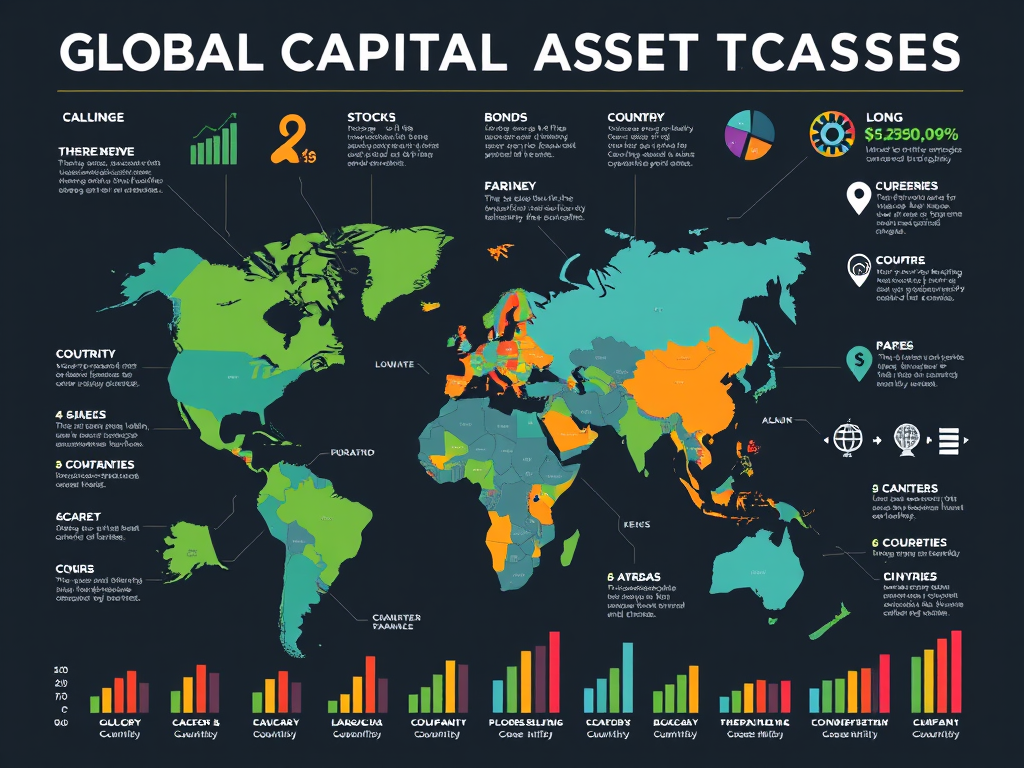
Welcome to a simple guide to capital asset markets. Capital markets serve as the backbone of the global financial system, facilitating the flow of capital from investors to entities seeking funds for growth and development. These markets encompass a wide array of instruments and sectors, each playing a distinct role in economic activity.
This article provides an overview of key components of capital markets, including indices, sectors, industries, metals, energy, agriculture, fixed income, currencies, and countries.
Introduction to Capital Asset Markets
These markets encompass a broad spectrum of global asset classes. Here, we dive into an overview of these areas: broad indices, sectors, industries, metals, energy, agriculture, fixed income, currencies, and countries.
To stay consistent, we represent all capital asset markets in this article using a well-known exchange traded fund (ETF). This gives us a standardized approach for analyzing these markets, plus the added benefit of ease of tradability using ETFs.
Exchange Traded Funds & Capital Asset Markets
An exchange trade fund (ETF) is an investment vehicle that combines key features of traditional mutual funds and individual stocks. Trading ETFs is as simple as buying and selling stocks.
Furthermore, an ETF exists to represent virtually every market, sector, industry, currency, commodity, you name it. There are even ETFs representing market cap categories, countries, and world regions.
Let’s explore some of these asset class categories.
Indices
Major market indices are benchmarks that track the performance of a specific group of securities, offering investors a snapshot of market trends and economic health. Prominent examples include the S&P 500 and the Dow Jones Industrial Average (DJIA), which reflect the performance of large-cap U.S. equities.
These indices act as indicators of market sentiment and are used by investors to gauge performance and compare investment returns.

While these indices give us a representation of broad markets, we may want to breakdown those markets into their sectors. Let’s do that.
Sectors
Sectors represent groups of companies operating in similar industries. Major sectors in capital markets include technology, healthcare, financial services, consumer goods, energy, and utilities.

Furthermore, each sector responds differently to economic cycles and monetary policy. Hence, investors can diversify risk and target specific growth areas. For instance, the technology sector often leads during periods of innovation and economic expansion. However, utilities and consumer staples tend to be more stable during downturns.
Industries
Industries are more specific groupings within sectors, focusing on particular business activities. Examples include automotive manufacturing, pharmaceuticals, telecommunications, and retail.

Factors such as supply chain dynamics, regulatory changes, and technological advancements influence the performance of individual industries. For example, improvements in mining technologies facilitate more efficient output in the metals and mining industry.
Commodities in Capital Asset Markets
Commodities are generally classified into two main categories: soft and hard commodities.
Soft commodities are primarily agricultural products that are grown or harvested, such as wheat, corn, coffee, sugar, cotton, and livestock like cattle and hogs.
Hard commodities, on the other hand, are natural resources that are mined or extracted from the earth, including precious metals like gold and silver, industrial metals such as copper and aluminum, and energy sources like crude oil, natural gas, and coal.
Let’s explore some of these.
Metals
The metals market is a key component of commodity capital markets, which includes both precious and industrial metals.
Precious metals such as gold, silver, and platinum are considered safe-haven assets. Hence, investors and traders use these for hedging against inflation and currency devaluation.
On the other hand, industrial metals like copper, aluminum, and nickel are essential for manufacturing and infrastructure development.

Global demand, geopolitical events, and supply chain disruptions heavily influence prices of these metals. The London Metal Exchange (LME) and other global exchanges facilitate trading in these commodities.
Energy
The energy sector within capital markets includes companies involved in the exploration, production, refining, and distribution of oil, natural gas, and uranium.

Crude oil and natural gas trade on major exchanges such as the New York Mercantile Exchange (NYMEX) and the Intercontinental Exchange (ICE).
Energy prices are highly sensitive to global supply and demand, geopolitical tensions, and environmental policies.
Agriculture
Agricultural commodities such as corn, wheat, soybeans, coffee, sugar, and cotton trade in capital markets to manage price risk and ensure supply chain stability.

These markets are vital for farmers, food processors, and consumers. Prices are influenced by weather patterns, crop yields, trade policies, and global demand.
Fixed Income
Fixed income markets are central to capital markets, providing a platform for governments and corporations to raise long-term capital through the issuance of bonds, debentures, and other debt instruments.

These securities offer investors predictable returns in the form of interest payments. The U.S. Treasury bond market, for example, is one of the largest and most liquid fixed income markets globally.
Fixed income securities are categorized by maturity, credit quality, and issuer type. This allows investors to tailor their portfolios based on risk and return objectives.
Currencies
The foreign exchange (forex) market is the largest and most liquid financial market in the world, with daily transactions exceeding $7.5 trillion. It involves the trading of currency pairs such as USD/EUR or JPY/USD. Participants include central banks, commercial banks, multinational corporations, hedge funds, and retail investors.

The forex market enables international trade and investment by facilitating currency conversion and hedging against exchange rate risk. It operates 24 hours a day across global financial centers and is decentralized, relying on a network of banks and brokers.
Countries
Capital markets vary significantly across countries, shaped by economic conditions, regulatory frameworks, and investor base.
Developed economies such as the United States, Japan, and Germany have mature and highly regulated capital markets, with deep liquidity and sophisticated financial instruments.
Emerging markets like India, Brazil, and South Africa offer high growth potential but come with higher volatility and risk.
Countries with strong institutions, transparent regulations, and stable currencies tend to attract more foreign direct investment and have more developed capital markets. The performance of national capital markets is closely tied to macroeconomic indicators such as GDP growth, inflation, and interest rates.

Further Research on Capital Asset Markets
It is important to follow these markets to gain a global holistic perspective. However, studying these markets in isolation does not paint the entire picture.
For a better understanding of how these market interrelate, take a dive into intermarket analysis.
Capital Asset Markets: Where to go Next
For beginners just starting to learn about the markets and its interrelationships, it’s best to just start watching the markets. Do this by simply monitoring price action and charts from the major global asset classes.
Learn how you can start following the major global capital asset markets here.